Barbados

Barbados 2006-10 Home
Barbados 2006-10 Away
Barbados 2011-13 Home

Not the world’s most interesting shirt, but possibly the world’s largest. Locust weren’t keen on small shirts, it seems. The home is ok, with blue across the shoulders and under the arms with a calmer curves on the front and a thicker one on the rear. A difference on the rear of the shirt that isn’t just it being plain is unusual, but let’s not hang it in the Louvre just yet. The logo fits into the body of the shirt well though. The away ditches multiple colours and looks much more plain, sadly.

2010 World Cup qualifiers came with a brutal format for 2 double header knockouts before a group stage. Barbados would edge their way past Dominica 2-1 on aggregate but then had the hard luck to be drawn against the USA. After an 8-0 demolition in the first leg, the US could take things easily and only managed 1-0 in the second leg, though the damage had long been done.

One Sports make an even plainer shirt, though do use a more ocean-y shade of blue. Flag vs geography so hard to say which the shirt is better for. The use of blue is less interesting, only at the collar, shoulders and base of the shirt with the attempt to make up for it seemingly being One’s insecurity in plastering their logo everywhere. Again, not a great shirt, but just above being totally plain.

Used across 2014 World Cup qualifiers, Barbados were drawn in a group with Guyana, Trinidad & Tobago and Bermuda. Things didn’t exactly go well, with them losing their opening three matches 2-0 and following that up with a 4-0 loss away to Trinidad & Tobago. Their final two matches were closer, both being 2-1 losses, but 0 points from 6 matches left them 10 points adrift of even 3rd place as the rest of the group scrapped for the place in the next round.

Sometimes they’re quite a strong Caribbean side, but generally struggling in qualifiers is very much Barbados’ lot. They rarely make it far in World Cup qualifiers, with the biggest sides of the confederation typically punishing them if they do. They also had a bit of a gap in the 1980’s from major qualifiers, not that it seemed to help them. They’ve never been to a Gold Cup but have occasionally come semi-close to doing so. The Caribbean Cup has brought a little more success, with 9 appearances, including at the 1990 tournament abandoned mid-coup d’etat in Trinidad & Tobago. Their best came in 1985 and 2005, both tournaments they hosted, where they would come 2nd (after 3 draws in a group of 4) and 4th (3 losses in the same scenario). Initially in League C of the Nations League after only beating the US Virgin islands in qualification they were quickly promoted but then only saved from relegation by restructuring, a fate which could only save them for 1 season.

Their women’s team has appeared somewhat more sporadically, and has also struggled for positive results. They’ve taken a few positive results since their introduction in 2006, and have avoided some of the more extreme one-sidedness of some of their compatriots. 3 wins in 2010 qualifiers is the closest they’ve come to a major tournament, but the 2 qualifiers from their final group dealt with Barbados comfortably. They’ve not yet won in CFU competition, however. The men’s youth teams have managed some success, with the U20s qualifying for 5 tournaments prior to 1992, but only 1 since. In contrast, the U17s have been to 4 since 2010. No major successes have been achieved. The U15s got promoted to League 1, but immediately were relegated. Their women’s youth sides have struggled in several qualifiers, but have managed to come close on a few occasions. They barely made the 2020 U20 Championship, but the insane CONCACAF setup led to them getting immediately knocked out 12-0 by Haiti.

Not a futsal nation, Barbados have managed to appear in the 2015 and 2017 beach soccer championships. They failed to win a single group stage match in either, only beating Turks and Caicos and the US Virgin Islands in placement matches to finish 15th! They haven’t since returned.

In a group with Panama, Dominican Republic, Dominica and Anguilla, Barbados were not expected to progress, but managed 4 very close results, drawing to the Dominicas, beating Anguilla 1-0 and only losing 1-0 to runaway group winners Panama. Far better than their Nations League performances would have indicated, but not significant in the long run.

Bangladesh

Bangladesh 2014-15 Home (DUBIOUS)
Bangladesh 2016-20 Home

If you have OCD, look away! The FA logo doesn’t quite go into the cross and now that’s all you can see. Regardless, the cross provides some good emphasis along with the fade effect between the two shades of green. Stripes on the shoulders add some extra detail too. It may be a template, but this is the sort of detailed template that works really well.

Mainly used across 2018 World Cup qualifiers, Bangladesh had to compete with Australia, Jordan, Kyrgyzstan and Tajikistan. Both losses to Kyrgyzstan were only by 2 goals and they took a point off Tajikistan with a 1-1 home draw but these were the highlights. 2 goals scored at home and none away, capped by some large scorelines, meant they were comfortably eliminated.

How much detail should be added to the shirt? ALL OF IT! One side of the shirt has been attacked by a tiger, the other side is patterned with squares in a sort of lattice effect and, in case you didn’t recognise the logo, a giant flag and country name replaces a manufacturer logo. We’ve got two colours on the collar, stripes coming across the shoulders, there’s a lot to take in here. Then, in case that wasn’t enough, it all fades between two shades of green again. Phew, at least the back will be calm, right? One sleeve in lattice effect, one sleeve plain, some random yellow stripes and a giant Tiger face roaring at you! Completely bonkers and exactly the sort of thing you love to see.

Variants have been around for some time with them seeing use in 2018 World Cup qualifiers, 2019 Asian Cup qualifiers and 2022 World Cup qualifiers. They were handily beaten by Tajikistan and then beaten by Bhutan to cap their 2018 qualifiers with elimination from the 2019 Asian Cup qualifiers. However, for 2022, they edged Laos 1-0 over 2 legs to get into a group consisting of Qatar, Oman, Afghanistan and India. Scorelines have been very respectable, but after 5 games played they ‘ve lost to everyone but India, whom they shared a 1-1 draw with.

These results are not atypical for Bangladesh who have never taken more than 2 wins in a single set of World or Asian Cup qualifiers. They failed to qualify for 3 AFC Challenge Cups, qualifying as hosts for 1 and through the groups for the other. But they have had successes. The 2006 Challenge Cup had them progress to the quarter-finals, drawing with Palestine and beating Cambodia and Guam, before Tajikistan crushed them 6-1. Most successful in SAFF, they missed out on the semi-finals on goal difference in 2019, were knocked out in the semi-finals by eventual champions India in 2009 and reached 3 consecutive finals between 1999 and 2005! Two 2-0 losses to India sandwich their victory on penalties over the Maldives to take home their only title. A gold, 4 silver and a bronze medal make up their haul from when the South Asian Games was made up of full national sides and they also tend to take part in a number of other minor/friendly tournaments.

Their women’s side lost all three games in 2014 Asian Cup qualification, their only attempt to date, but has been active in SAFF since 2010. From 5 SAFF Championships they’ve reached a final and 3 semi-finals, but have never beaten India or Nepal (1 draw against India in competitive play). The South Asian Games have brought similar results, with them taking the bronze medal both times to date (they didn’t attend 2019), losing out to India and Nepal once again. Their men’s youth sides have a South Asian Games title from 2010 (and 2 bronzes). Otherwise, the U23s have been similar to the senior side, finishing at or near the bottom of U23 Asian Cup qualifying and the Asian games.  The U20s and U17s have each been to several youth Asian Cups but not since 2006. Twice they’ve been close to escaping the group stages but typically have not posted good results. The U14s managed a solitary draw in their one campaign. While the women’s U23s and U19s have played sporadically, they’ve had little success. The best results have come from the youngest groups, with the U17s qualifying for 3 Championships (often comfortably), though not winning a game at any of them. The U14s finished middle of the pack initially, before taking a one tournament break to return for 2 regional titles in a row, showing that the potential is there if the coaching and facilities can match it.

Perhaps as expected, Bangladesh have never participated in men’s futsal or beach soccer to date within the Asian Football Confederation. Somewhat surprisingly, they entered a women’s futsal team to the 2018 AFC Championship where they lost 7-1 to Malaysia, 7-0 to Vietnam and 6-1 to Chinese Taipei, though they weren’t the worst team at the tournament.

Already eliminated from 2022 qualification, Bangladesh can take heart from their progression out of the preliminary qualifying rounds. This guarantees them a further path in Asian Cup qualification as well as proving that they are not amongst the bottom 6 nations of the AFC.

Bahamas

Bahamas 2014-15 Home
Bahamas 2022-23 Home

So, we start off with old enemies Forward. So yes, the shirt is cheap, yes the quality is poor, but there’s at least a little design involved. Everything is printed too, which is disappointing. But we have three colours involved, with the pale blue and black curves livening up the sides of the shirt and blue across the shoulders to prevent it just being yellow. There’s a little bit there, which is admirable in a way. But yes, it isn’t great.

Used very briefly across their 2018 World Cup qualification campaign, the Bahamas started off life in the very first round against Bermuda. That would also be where they ended their qualification campaign, as is often the case after 3 and 5-0 defeats and it was this style of campaign that persuaded CONCACAF to update their system finally.

Next up is much better. Hummel decided to get involved with the Bahamas and absolutely hit the nail on the head with this flag shirt. Of course, the home shirt has the inverted colours, but the titled flag design, the golden sandy colour throughout and the Hummel detail down the sides really works. It does mean that the sleeves and rear of the shirt are somewhat plain and with the details all still printed then it isn’t perfect by any means. But it is a great shirt nonetheless.

These shirts have seen a little more use, with a 2-0 loss to Guadeloupe in a 2021 Gold Cup play-off and their newly expanded 2022 World Cup qualification campaign. Drawn in a group with Trinidad & Tobago, St Kitts and Nevis, Puerto Rico and Guyana, the Bahamas weren’t expected to rock the boat and generally didn’t, with 3 heavy losses, until their stunning 0-0 draw against Trinidad & Tobago! This prevented the other islanders from progressing and was one of the great shocks of the 2022 qualifying campaign.

The losses are more in tune with the Bahamas’ typical performance, though they often have a result or two to tide them over. The 2018 campaign was their only World Cup qualification attempt without at least a draw and, while largely inactive, they progressed through a round on each of their 2 Caribbean Cup qualification attempts. The Nations League has even brought them some success with an immediate promotion from League C in their first season followed by a decent struggle to try and stay in League B. They may historically be one of the weakest sides, but in their tier never underestimate them.

Unsurprisingly, their women’s side has also not been very active, though they take things to even more of an extreme. They briefly tried to compete in the early 2000’s, with qualification attempts for the 2000 Caribbean Cup and the 2002 Women’s Gold Cup, but after those 5 losses they stopped. A handful of recent friendlies have proved they’re not completely gone, even bringing a victory over the Turks and Caicos Islands, but their women’s football remains very limited. As with many small countries, their men’s youth teams tend to trade participation between U17 and U20 level, with the U20s being rarer and dropping out of the picture since 2009. Entering Olympic qualifiers is very rare but they do also compete at U15 level and across youth football have ranked as high as pot 2 out of 4, but don’t trouble the nations that qualify and often struggle regardless. Their women’s youth teams have both been more active and more variable than the senior side. They played at all levels and have varied from disastrous, to really quite dangerous, particularly in the Caribbean. Active across the last 10 years, the highlight has to be their 2012 U17 CONCACAF Women’s Championship appearance. They qualified as one of the weakest of CFU, but managed a draw against Trinidad and Tobago despite being in a very tricky group (other teams were Mexico and the USA).

Not a futsal side, the Bahamas are more known for their beaches and thus their beach soccer. The first Caribbean side to ever compete in CONCACAF beach soccer, the Bahamas have played in the Championship since 2009 and are now regulars in the quarter-finals. They even hosted the 2013 and 2017 editions, along with the 2017 World Cup. The World Cup brought them a victory over Ecuador, but a heavy loss to Senegal and a narrow (2-1) loss to Switzerland sent them out in the groups. Nonetheless a dangerous side in the sport.

The Bahamas weren’t expected to do anything in 2022 qualifying, despite the expanded system. The likes of Puerto Rico and Guyana ended up too much for them and they would never be expected to take points from the top two. However, a stunning 0-0 draw against Trinidad & Tobago helped cement their WCQ record of generally scoring points, as well as upsetting the group entirely. Not what was expected, but very welcome.

Australia

Australia 1998-2000 Home
Australia 2010-11 Home

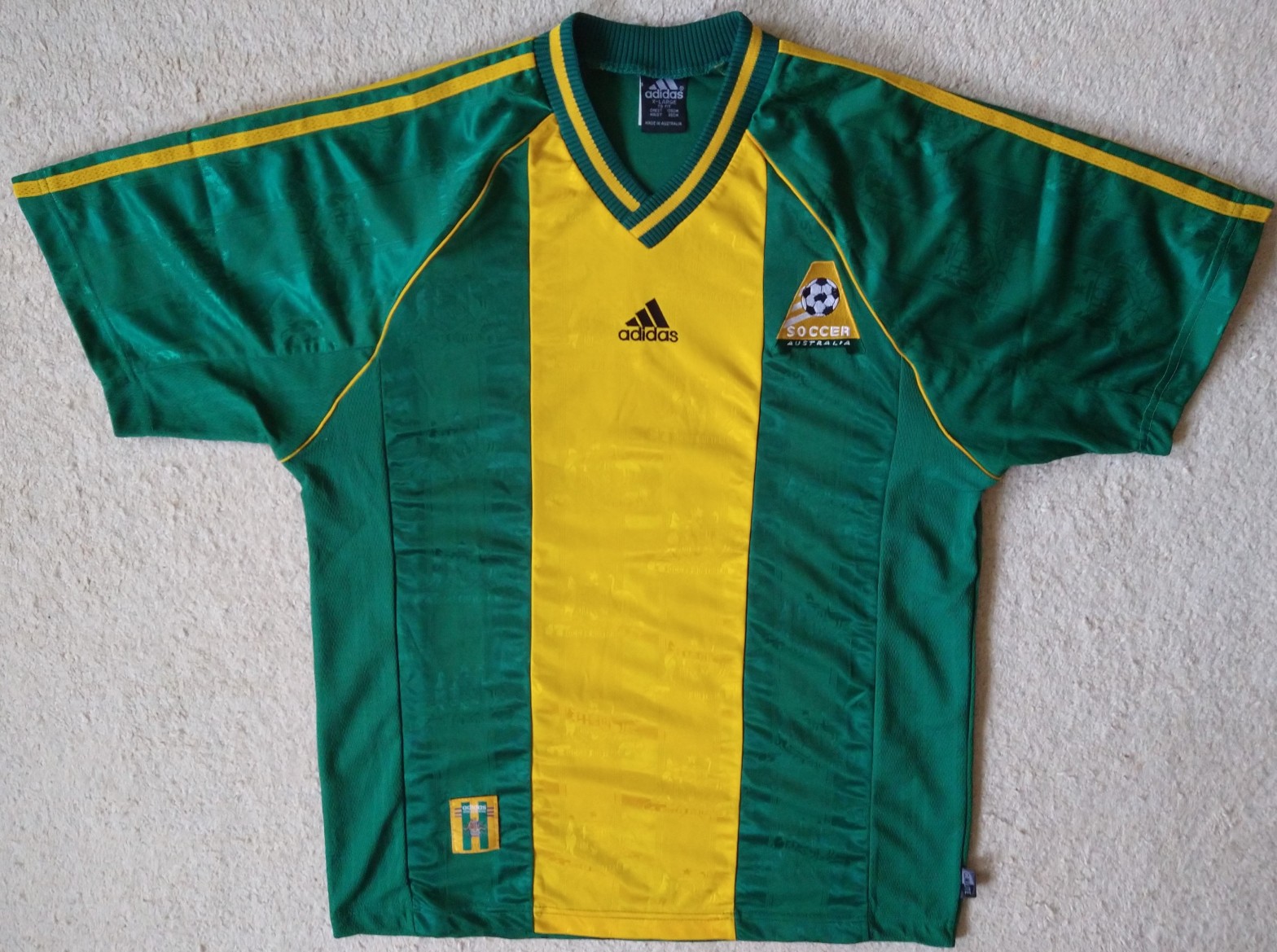
Let’s start things off with the spectacular. Keeping the traditional 2 colours of deep green and yellow, the stripe down the front divides it up nicely. Additionally, adding the yellow trim across the sleeve boundaries, for the three stripes and the same pattern as the front in the collar keeps the shirt interesting enough without breaking up the main colour. The old FFA logo is also fairly striking, if a little dated, adding to the appeal. Lastly, just in case you aren’t certain it is an Australia shirt, the national crest is printed into the fabric across almost the entire shirt! A beautiful shirt, and one of my favourites from down under.

As they were still in the OFC at the time, Australia used this shirt in the 2000 OFC Nations Cup. Supremely comfortable 17-0 and 6-0 wins over the Cook Islands and the Solomon Islands sent them through to the semi-finals. In the semis they faced a resilient Vanuatu side who conceded only a penalty all game. Nonetheless the 1-0 victory sent them through to face New Zealand where the Aussies would defeat their Kiwi neighbours 2-0 to retake their continental title and qualify for the Confederations Cup.

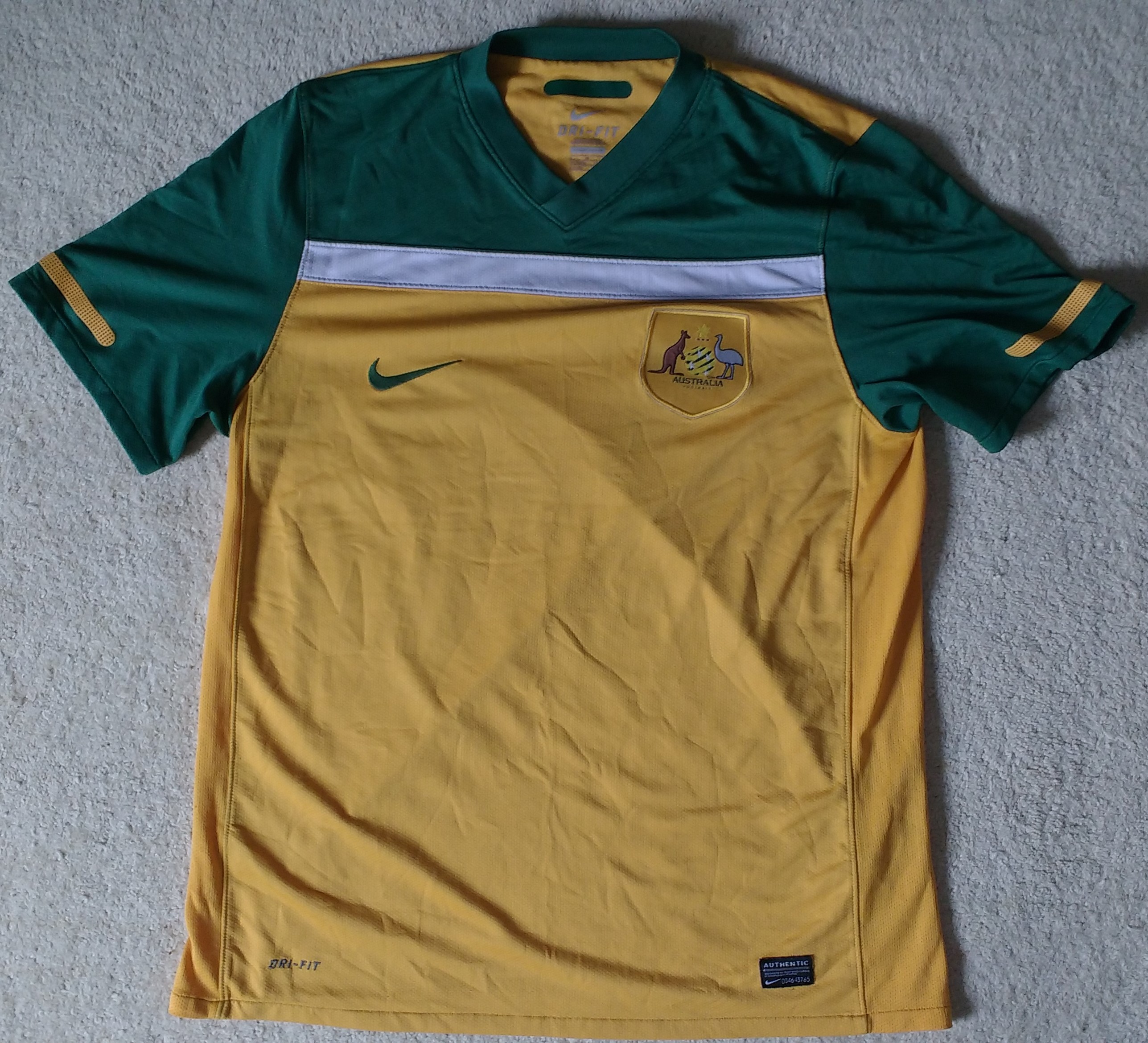
Somewhat less spectacular is this Nike template. We keep both of the traditional colours but separated by the band of white this time. Overall it feels a lot more muted: no pattern to the fabric and all very standardised. The modern logo comes back into play and there are bands of yellow on the sleeves but we’ve lost the detail and the interest behind it. It is decent enough, but nothing more. Being able to compare it to its forebears highlights the deficiencies, sadly.

Shirt was worn across the 2010 World Cup and the 2011 Asian Cup. In the former, a 4-0 loss to Germany proved to be the flaw in their campaign, with a 1-1 draw against Ghana and a 2-1 victory over Serbia sending them out on goal difference. The Asian Cup proved a little better for them, with victories over Bahrain (1-0) and India (4-0) combining with a 1-1 draw against South Korea to send them through to the knockouts. It took extra-time to grant them a 1-0 victory over Iraq, before they annihilated Uzbekistan 6-0 to reach the final. Sadly, extra-time giveth, extra-time taketh and Japan edged them 1-0 in the final.

Overall these results are fairly typical for Australia. While in the OFC they took part in 6 Nations Cups, winning 4 but losing the final to New Zealand in 1998 and 2002. Overall, they were dominant, scoring 142 and conceding only 13 across 28 games. Since their move to the AFC in 2006 they’ve been to 4 Asian Cups. On every occasion they’ve reached the knockout stages, reaching the final in 2011 and 2015, winning in 2015. These successes have sent them to 4 Confederations Cups, though they’ve struggled more there. They finished in 2nd in 1997 and 3rd in 2001 but haven’t progressed past the Group Stages since. In the World Cups, their performance has been more similar to the Confederations Cups. Traditionally reaching the play-offs in qualification (9 times from 14 attempts!), Australia first reached the World Cup in 1974 and have returned in every edition from 2006 onwards to date. At the cups, they’ve struggled to maintain their form, with only 2 wins, reaching the quarter-finals in 2006. To assuage the pain of some of their defeats, they have a host of minor titles from small tournaments across Asia/Oceania.

On the women’s side, Australia are more intimidating. They started out slowly, typically falling short of New Zealand and getting three 2nds and a 3rd place (also behind Chinese Taipei) in their first 4 tournaments. From then on, they were dominant though, with 3 titles from 3 tournaments, before a move to the AFC where they reached 4 of 5 finals (winning in 2010). They’ve also been to 3 Olympic Games and 8 World Cups, reaching the knockout stages in each of the last 4 World Cups and 2 of the Olympic Games. Regarded as one of Asia’s strongest sides and a distinct power in the world, the Aussie women can’t be underestimated. Across youth football we see some familiar patterns, with the men reaching 6 from 8 Olympics (including a 4th place) and holding a string of OFC titles before shifting to AFC bronzes and AFF golds. Recent performances have been a little shakier, but they’ve reached 28 combined men’s youth World Cups with two U20 4th places and runners up in the 1999 U17 edition. Women’s youth football has been surprisingly quiet, with three U20 World Cup appearances, mostly qualifying from OFC competition and mainly 4th and 5th place finishes across AFC competition. They’ve been runners up twice in U20 AFF football and champions once at U16 level but fall somewhat short of the senior side.

Highly active in futsal, Australia were kings of the OFC, winning every Championship game they played, often convincingly. Regulars in the AFC knockout stages, they’ve reached only 1 semi-final, finishing 4th in 2012. They’ve had more luck in the AFF, reaching but losing 4 finals to Thailand in all 4 of their appearances. This has led them to 7 FIFA World Cups and 6 AMF World Cups, though only a handful of wins means that they’ve typically been eliminated in the first round. They;’ve played women’s futsal previously but don’t appear active within the AFC. Beach soccer has been much quieter, with an appearance at the 2005 World Cup (they lost both games) followed up by appearances at the 2009 and 2013 AFC Championship, where they performed reasonably but unspectacularly.

Drawn with Kuwait, Jordan, Nepal and Chinese Taipei for their 2022 2nd round qualification group, Australia were expected to proceed comfortably and have done so, with a 100% record. Assuming they get a favourable draw, they are expected to qualify for 2022 automatically, though an unfavourable one may send them into the play-offs. Not qualifying is not really an option for them.

Argentina

Argentina 2018 Home

You can’t go far wrong with Argentina; their home template of the light blue and white stripes has been around for donkey’s years. Long term servants of Adidas, very little has changed here and very little needed to. Does feel a bit cheaper than I’d like and isn’t exactly innovative (even the black stripes on the shoulders first appeared in the early 2000’s) but it does what’s needed of it. At least, as a classic kit, it is more interesting than plain colour.

This is the World Cup 2018 kit, where Argentina fell in the knockout stages to eventual winners France. A topsy-turvy loss in the Round of 16 summed up their tournament nicely, with them being one of only 2 teams to advance with only 4 points. A draw with Iceland was followed by a 3-0 loss to Croatia, leaving them to reply on a late winner, by Marcus Rojo of all people, against Nigeria to barely advance. Defensive inadequacies and a surprisingly like of bite in the attack blunted them throughout.

Argentina need no introduction, having only failed in WCQ for the 1970 tournament (though they did not enter 1938, 1950 or 1954). They’ve twice won it and fallen at the final hurdle 3 times with them only failing to reach the knockout stages once since their failure to qualify in 1970. Despite a lack of Copa America titles since their 1993 triumph, they remain the second most successful team (though have lost more finals than anyone else too). In addition they have 3 medals from the Confederations Cup (1 title, 2 runners-up) and 7 titles (from 15 qualifications) from the Pan-American Games. They will remain one of the most successful teams in the world for some time, even if their performances start to slip.

Their women’s side has been less successful, but are still enviable. Champions of South America in 2006 and thrice runners-up, they’ve been to the World Cup 3 times, though never won a game. In the latest edition they had 2 draws, including a late comeback against Scotland and all their results were respectable. They’ve never emulated the men in their Pan American Games, but again a silver medal in 2019 isn’t anything to sniff at. The pattern continues in their youth sides with success remaining a theme throughout. On the men’s side there are 2 Olympic golds, 6 U20 World Cups and 3 U17 World bronzes along with numerous youth championships in South America (even down to the U15 level). The U20 women have 3 runners-up finishes in the continent and 3 group stage exist at World Cups while the U17s have two 4th place finishes to show continentally but no World Cup qualifications.

A string of medals also accompany their futsal side, though they often fall short against neighbours Brazil. 1 FIFA World Cup and two AMF titles, 2 Copa Americas (only once not won a medal in 12 attempts) as well as numerous medals across other competitions establish them as titans of the sport. Beach soccer, in contrast, is a little average. A 3rd pace in 2001 and a 4th in 1997 are the stand-out results but group stage exists are regular. They didn’t qualify for the 2017 or 2019 World Cups, though always being in the top 4 in South America isn’t exactly shameful.

Despite having not played any qualification games so far for 2022, they will be expected to qualify, no questions asked. 2018 was a struggle near the end and they did lose 6-1 to Bolivia in 2010 qualification but they’ve not fallen short in a long time.

Anguilla

Anguilla 2012-13 Home

Few places can live up to the spectacle of an Anguilla shirt. The three dolphins of Anguilla surround the number in the centre of the chest and the whole thing is a lovely ocean blue without looking too plain. That there’s another shade of blue as a subtle trim certainly helps. Part of this is the distinctive striped pattern on it that helps indicate that it isn’t a fake. The collar is terrible, nothing will ever make me like them, and the details are all sublimated but the latter certainly isn’t unexpected. The desire to avoid a plain shirt and include some of the identity of Anguilla shows and isn’t that what matters?

This design was used in their famous 2014 World Cup qualification attempt. Wait, did I say famous? I meant short. They lost a double header against the Dominican Republic 6-0 (who went on to do respectably but not well) in the very first round of CONCACAF qualifying and that was it. Nonetheless, it ranks as one of their most success campaigns. They weren’t even allowed to play at home, but, considering their record, it probably wouldn’t have mattered.

Traditionally the tiny Caribbean island (a British Overseas territory) has followed the same pattern of results throughout their history. They joined FIFA in 1996 but didn’t take part in World Cup qualification for the ’98 world cup (it having already started) and have 1 draw in 10 games. This came in 2006 against the Dominican Republic. They’ve only ever played a single double header in WCQ, with 2 goals across 2 games against the Bahamas (5-2 loss on aggregate) being the only time they’ve scored. 2010 was their low point, with a 12-0 away loss and a 4-0 “home” loss to El Salvador. They’ve never progressed in the Caribbean Cup qualification and typically suffered there too. However, a few bright spots emerge when looking at their results against their neighbours, with the BVIs proving to be a competitive game. The Nations League brought then a draw against the Bahamas and then sadly a group with Guatemala where they lost heavily, and Puerto Rico, whom they almost drew with at home.

 Their women’s national team has been simultaneously more sporadic and more successful. Several of their games weren’t FIFA recognised but a few friendlies and an attempt at qualification for the Women’s Caribbean Cup in 2010 form the backbone of their results. A 3-0 loss to Barbados and a 2-0 win against Grenada were not enough to qualify. Their main competition has been against Antigua & Barbuda and the US Virgin Islands, though a handful of friendlies hardly merits that description. In terms of youth teams, a familiar pattern emerges. The men’s U20 side has 1 goal scored and 107 conceded in 14 games, the U17’s are harder to find information on but appear to have never won a game (though score more often) and the U15’s have 2 victories in 6 games but are only competitive against their fellow minnows. The women’s sides have again fared better, with 0 points being a rare sight, though the U20s take the crown for reaching the second round of 2014 CONCACAF Women’s Championship qualification by storming their group, 3 victories and only a single goal conceded. A draw with Grenada and 2 heavy losses ended their charge in the next round. All play irregularly.

Despite being an island nation, beach soccer doesn’t appear to have been played internationally and futsal follows the same trend.

Thus far they have not started qualification for the 2022 World Cup, but big things are not expected of them.

Design a site like this with WordPress.com
Get started